 sv

The study forms part of a broader research programme involving Plant, Sveafastigheter, IVL Swedish Environmental Research Institute and Chalmers. The results in the second part come from IVL’s methodological development of the ReCiPe calculation model.
Three questions for Fredrik Dahlgren, Sustainability Director at Plant
Has Plant received any reactions to the first part of Timber vs Concrete?
Yes, absolutely! Companies have shown considerable interest in calculating biodiversity loss, and we have started these calculations in our software with some customers. We have eagerly awaited the second part, which adds several important insights to the first. We have also seen interest from local sustainability initiatives and material producers.
What do you see when you compare conventional climate calculations with ReCiPe?
ReCiPe is more comprehensive but highly complex. Sweden’s construction industry lacks experience with it, and the calculation methods need further development. ReCiPe includes climate impact alongside other environmental impact categories, such as land use and water use. Climate calculations and declarations use a simpler methodology with which the industry has extensive experience.
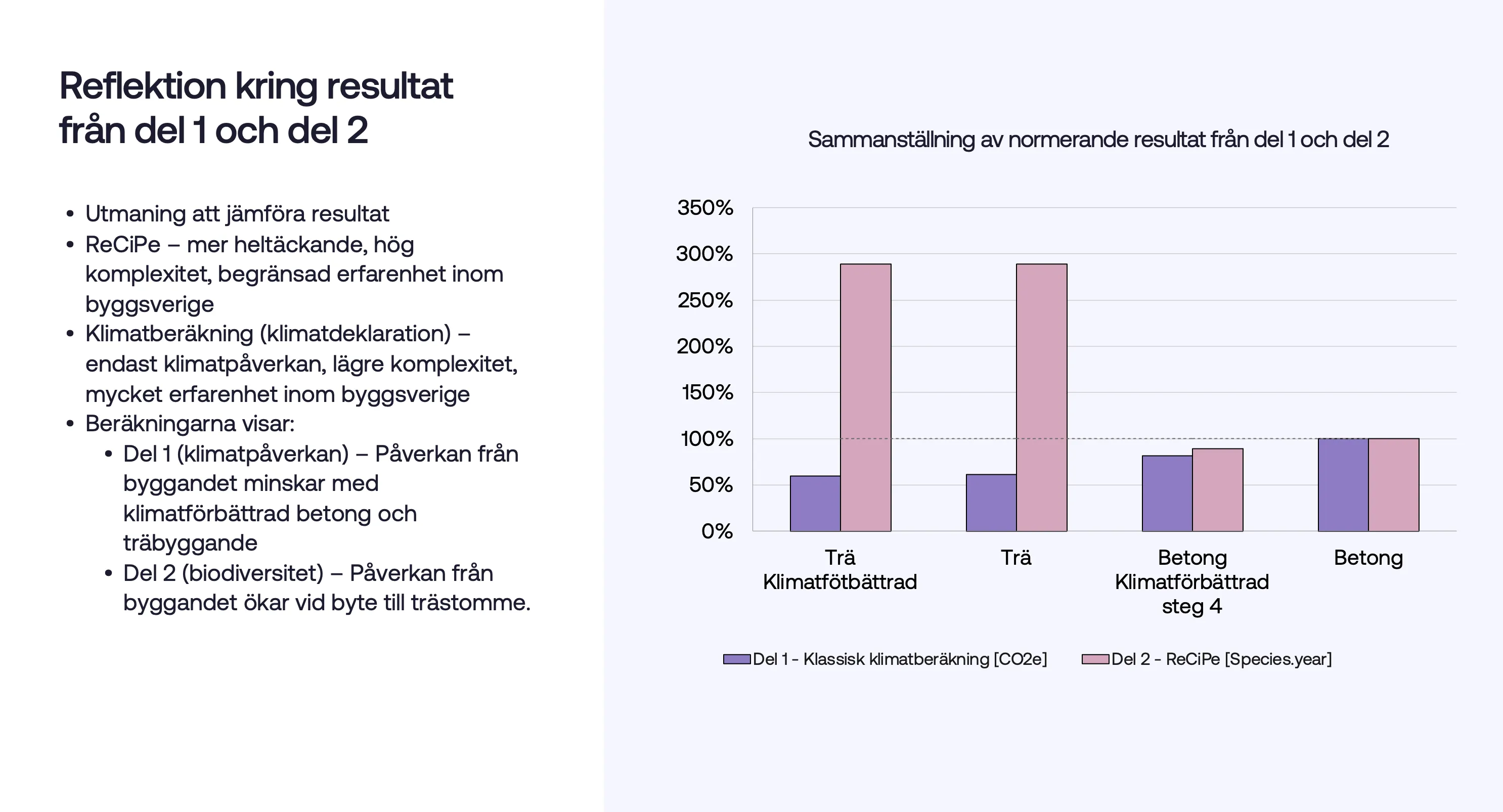
The first part of Timber vs Concrete includes several LCA calculations. The most conventional is the climate calculation, which shows that the concrete structure has the greatest impact when considering climate. This is illustrated as 100% environmental impact (see image). Environmental impact then falls when we choose lower-carbon concrete and, subsequently, timber construction.
In the second part, by contrast, impact increases when choosing a timber structure. That result captures more environmental aspects through the ReCiPe method.
We believe they should be considered side by side to account for both climate and ecosystems. We have extensive practical experience of climate calculations, including the inputs they require and the outputs they provide. ReCiPe calculations are more complex and capture more important aspects. I think widespread combination of the calculations is still some way off, partly because climate calculations are so embedded in different targets and partly because we need to develop the more comprehensive models further. It is certainly a future possibility, though. By beginning to use ReCiPe or similar models, the construction sector can take important steps towards more comprehensive environmental assessments.
If the industry asks which material to choose for the lowest environmental impact, what is your answer?
The short answer is that both materials have an important place in sustainable construction.
I think it is very positive that the challenges of both materials are being highlighted. For concrete, the issue is climate impact. For timber, according to this study, it is land use. This helps us target measures appropriately, and I believe both concrete and timber construction benefit from this kind of analysis.
Timber vs Concrete report: Biodiversity in Life Cycle Assessments of Building Materials